
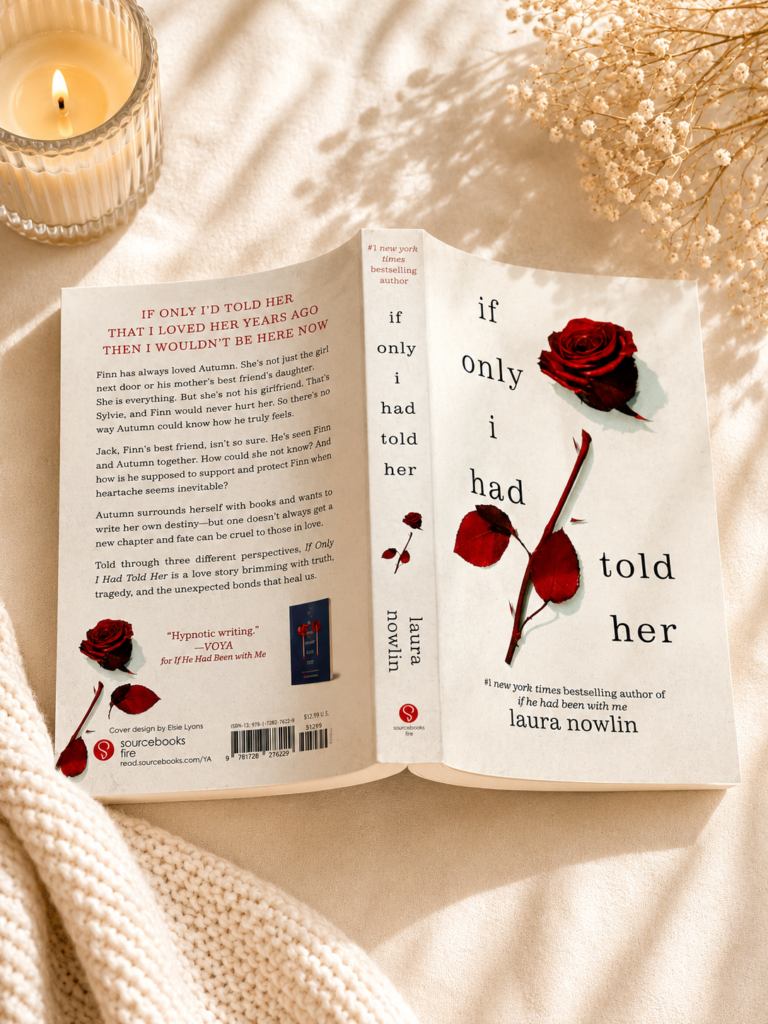
If Only I Had Told Her by Laura Nowlin
If Only I Had Told Her Review: Emotional, Heartbreaking, and a Different Perspective on Grief
After loving If He Had Been with Me as much as I did, I knew I had to read If Only I Had Told Her by Laura Nowlin as soon as it came out. I went into this book both excited and emotionally terrified because if you read the first book… well… you already know the emotional damage waiting for you.
This sequel (or companion novel, depending on how you classify it) overlaps heavily with the timeline of the first book, but instead of simply retelling the exact same story, it expands on it through different perspectives, especially Finn’s and Jack’s. Because of that, the pacing feels much faster than If He Had Been with Me. It almost assumes you already know the emotional groundwork and therefore does not spend as much time rebuilding every scene in detail.
Personally, I think that choice worked. The story feels less like a repeat and more like looking at the same heartbreak from different angles.
Finn’s Perspective Changes Everything
Getting Finn’s perspective was probably the most emotionally devastating part of the entire book.
In the first novel, so much of Finn exists through Autumn’s lens: idealized, misunderstood, loved, and ultimately lost. But in If Only I Had Told Her, readers finally get to sit inside Finn’s thoughts, and honestly? It hurts in a completely different way.
There is something especially painful about revisiting events when you already know exactly where the story is heading. Every sweet moment suddenly feels heavier because you are reading it with the ending already sitting in the back of your mind.
As heartbreaking as it was to revisit everything, especially the end of Finn’s story, there was also something strangely peaceful about hearing Finn’s side directly instead of only experiencing the grief through Autumn’s perspective. It added more emotional depth to his character and made the tragedy feel even more real somehow.
Which honestly feels rude of Laura Nowlin to do to us emotionally, but here we are.
Jack’s Perspective Was the Most Surprising Part
One of the biggest surprises for me was how much I loved Jack’s perspective. I think this may actually have been my favorite addition to the story because it explored a side of male friendship that we honestly do not see enough in books. Jack’s relationship with Finn is deeply emotional, loyal, complicated, and heartbreaking in a way that felt incredibly authentic.
Too often male friendships in fiction stay surface-level emotionally, but here you really feel Jack grieving the loss of his best friend while also trying to navigate the impossible emotional aftermath left behind. Jack’s perspective takes readers into life after Finn’s death and how everyone is attempting to survive emotionally afterward.
What I especially appreciated was the connection between Jack and Autumn. Their relationship works because they are tied together forever through their love for Finn. There is grief there, understanding there, and comfort there and thankfully, it stays platonic.
The SECOND I thought the story might push them romantically, I immediately started internally panicking because absolutely not. Some relationships are more meaningful when they remain rooted in shared love and grief rather than romance, and I am really glad the book recognized that.
The Pregnancy Storyline Added a Complicated Emotional Layer
Then we get into Autumn’s storyline and the pregnancy. This part made me emotionally conflicted in a way I actually appreciated, because on one hand, Autumn is incredibly young, grieving deeply, and trying to process an unimaginable loss while also facing teen pregnancy. It is heavy. Really heavy.
At the same time, I found myself feeling strangely excited for her. There was something bittersweet but comforting about the idea that Autumn, her mother, and Finn’s mother would still have a piece of Finn living on through his daughter. Not in a way that “fixes” grief because nothing really does, but in a way that allows love to continue existing after tragedy. I think the book handled that emotional complexity fairly well.
It also opened conversations around grief, teen pregnancy, identity, and healing in a way that felt more nuanced than I expected. The story never pretends any of it would be easy, which I appreciated.
Final Thoughts on If I Had Only Told Her
Overall, I did not love If Only I Had Told Her quite as much as If He Had Been with Me, but I still genuinely appreciated it.
Instead of trying to recreate the exact same emotional impact, this book expands the story outward and explores grief, friendship, love, and healing from multiple perspectives. It feels more reflective, more emotionally layered, and more focused on what happens after tragedy instead of just the tragedy itself.
It almost felt open-ended enough that I could absolutely see another book someday focused on Autumn, her daughter, and the next chapter of their lives.